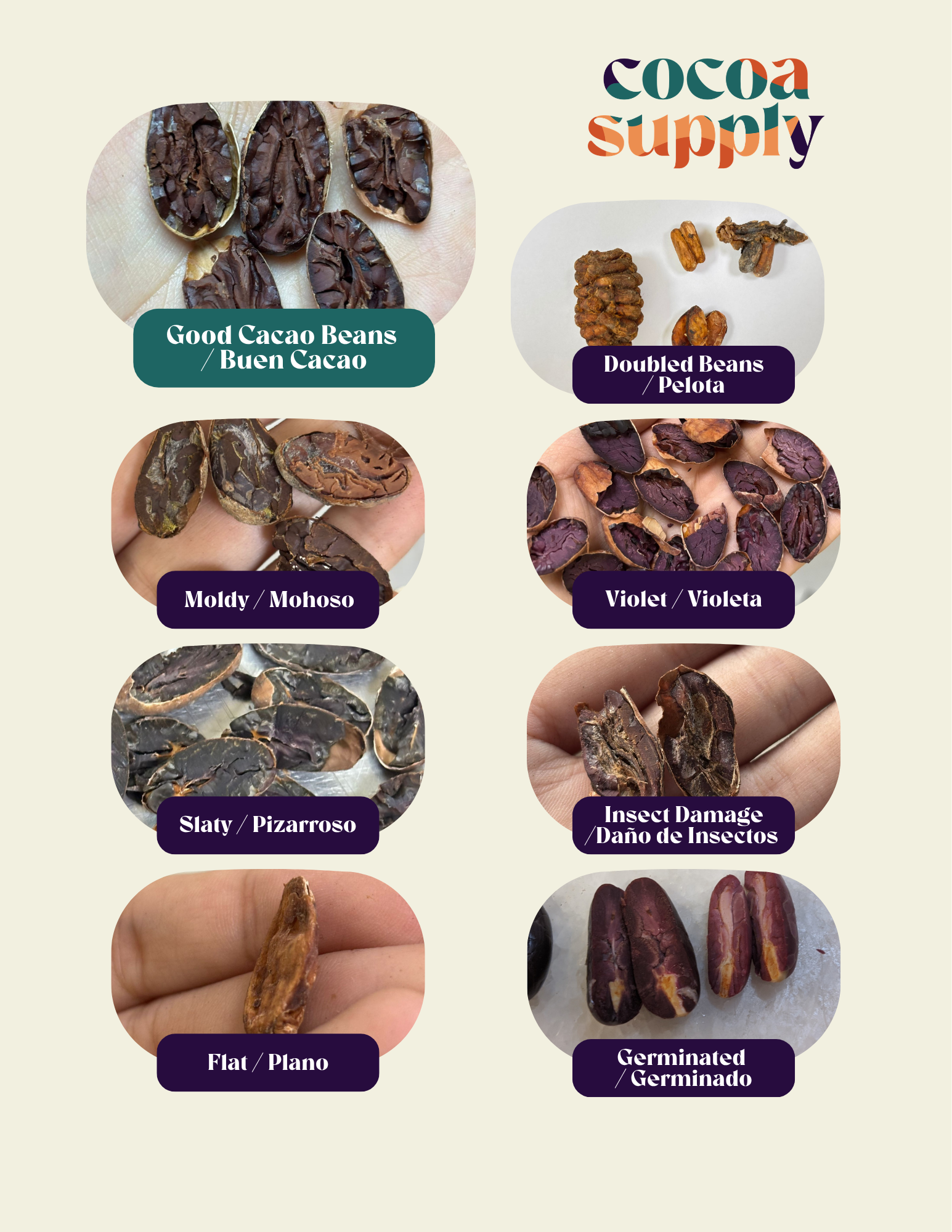
There are many terms and descriptions used in the industry to describe the quality of cacao beans. Each term will help determine the type of defect, the severity, and also help explain the root cause. This article gives a comprehensive listo of terms in English and Spanish to understand the standard terminology of cocoa grading.
1. Physical Defects
- Doubled bean / Pelota/pegados:
This happens at the drying stage, when beans are still sticky and not properly separated before fermentation or raked with the large, wooden fork while drying.. Roasting would be affected by the uneven beans.
- Moldy bean / Grano mohoso:
It is important to see if the inside of the bean has mold. It not only affects flavor, but also leaves toxins in the product (mycotoxins). Do not confuse some white mucilage or dust on the skin of the beans. Cacao blanqueado (whitened cocoa) sometimes occurs when beans are placed in plastic and cannot “breathe,” but it is still usable as long as it doesn’t penetrate the beans' insides. Moldy beans are those that have been infected inside and should not be used.
- Slaty bean / Grano pizarroso:
Bluish/greyish beans without the clear inner channels (properly opened cotyledon structure). This is usually caused by underfermentation or unripe cocoa. It creates an astringent, unpleasant taste.
- Violet bean / Grano violeta:
Purple inside, these beans are partially fermented. They will add bitterness and are due to short fermentation or to beans where the oxygen didn’t reach the center properly (poor aeration/turning).
- Insect-damaged bean / Daño de insectos:
Check for life pests (moths, worms, etc). Sometimes you will find a wool-like cocoon of cocoa moths, but if there are no live larvae, it was most likely killed during bean export, either through gas/heat/low-pressure/CO2 treatment. That is not a defect and can be used. Defective beans are those in which the insect penetrated or nibbled the beans. They become powdery inside as well. Too many insect-damaged beans inside indicate poor storage and prior pest contamination.
- Germinated bean / Grano germinado o brotado:
Pods were overly ripe when harvested. Bean germination usually stops at the fermentation stage, where the high heat “kills” the bean. Unpleasant flavor.
- Flat bean / Grano plano:
Thin, narrow, or flattened beans instead of the typical plump, full shape. Usually, unripe pods, poor fermentation, or beans at the edges of the pod are underdeveloped. Give a lower yield and uneven roasting.
- Shriveled bean / Grano arrugado:
Wrinkled, shriveled, or dried-out beans.
Appear smaller and irregularly shaped, sometimes hollow inside. Give a lower yield and uneven roasting.
- Broken bean, fragments / Grano roto, fragmentos:
Common cause is the beans are too dry and have been handled (screening, conveyor belt transport, dryer, rebagged). It will give an uneven roasting.
- Shell / Husk / Cáscara / cascarilla:
The most common cause is when beans are too dry, and some shell flakes off. But if it is too much, it can be an indicator of adulteration.
- Smoky bean / Grano ahumado:
This is considered a flavor defect. It is not really possible to mask a smoky flavor in chocolate. The most common cause is drying with fires fueled by wood, charcoal, or biomass.
- Foreign matter / Materia extraña:
Can be cocoa-related (sticks, dust, pod vein, shell) or non-cocoa-related (feathers, plastic, ropes). It will tell a lot about how the beans were dried (on a patio floor or on a table) and how they were handled.
2. Categories & Measurements
- Cacao or cocoa beans /Granos de cacao:
The terms cacao and cocoa will be used interchangeably for quality testing purposes.
- Grade 1 cocoa / Cacao Grado 1:
Highest grade, includes size, fermentation (between 70% and 90%), defects, and humidity (between 6% and 8%). Size varies by bean type and origin.
- Grade 2 cocoa / Cacao Grado 2:
Second and most common grade. Less fermentation, smaller bean size, and defectives allowed.
- Natural Size Grade:
bean sizes mix as they come naturally from the pod (in Ecuador, about 25% of Grade 1 bean size, 50% of Grade 2 bean size, and 25% of smaller size). This only affects size; the rest of the defects still count. Usually sold by small farmers.
- Undergrade cocoa /Cacao fuera de grado:
Others that can sometimes be a combination of the above, or beans that are of lower quality. Bulk beans and high in defects.
- Bean count per 100 g /Conteo por 100 gramos:
Depends on cacao variety, natural or screened/selected bean sizes. Standard counts are usually between 40 and 60 beans per 100g (as a reference).
Shop our quality-graded single-plantation beans San Jose beans
Below are the pictures of cocoa beans including all defects.